
Choosing a health tracker for menopause depends on what you want to learn: ongoing symptom and temperature patterns, or a snapshot of a hormone marker such as FSH. My top pick for broader perimenopause tracking is the Natural Cycles NC° Band, which automatically records overnight temperature and pairs it with cycle and symptom logs. For a wider set of hormone measurements, Proov Empower tracks four markers over two months, while the HORMONElife FSH kit offers a more focused screening routine with clear instructions and app logging.

Get wellness gear delivered free — and shop member deals
- Fast, free delivery on millions of items
- Access to Prime Big Deal Days deals on October 6–7
- Prime Video, Amazon Music and more included
The tradeoff is that these tools do different jobs. A wearable can help organize patterns over time, but it does not measure hormones directly; an FSH strip is more direct but offers only limited information and is not a diagnosis. I ranked these five by how clearly each supports menopause-related tracking, how practical its routine is, and how much context it gives a buyer. State availability, testing schedules, and the limits of home results matter as much as the headline feature.
Key Takeaways
- The NC° Band is the only wearable in this group and is the strongest fit for automatic overnight temperature tracking combined with cycle and symptom logs.
- Proov Empower measures FSH, LH, PdG, and E1G across two months, but it is unavailable in several states and its results may need professional interpretation.
- HORMONElife is a focused FSH screening choice with six strips, a color chart, app logging, and instructions for two three-day testing series.
- Carethetic supplies 12 strips for repeated FSH checks, while its product information provides less interpretation guidance and no stated app support.
- The five-count midstream FSH kit is the simplest cup-free test routine, but it uses a 25 mIU/mL threshold and recommends two tests a week apart.
| Natural Cycles NC° Band Perimenopause Tracker with 1-Year App Subscription |  | Best Overall for Ongoing Symptom and Temperature Tracking | Included: NC° Band wearable and one-year Natural Cycles app subscription | Metric measured: Body temperature | Tracking: Automatic overnight temperature, cycle tracking, and logged symptoms | VIEW LATEST PRICE | See Our Full Breakdown |
| Proov Empower Perimenopause Hormone Tracker for Women |  | Best for Multi-Hormone Tracking | Hormones tracked: FSH, LH, PdG, and E1G | Included tests: Four multihormone tests and three FSH tests | Tracking period: Two months | VIEW LATEST PRICE | See Our Full Breakdown |
| HORMONElife At-Home FSH Menopause Test Strips, 6-Pack |  | Best Guided FSH Screening Routine | Test type: Semi-quantitative FSH urine test | Quantity: Six individually sealed strips | Measurement range: 0–50 mIU/mL | VIEW LATEST PRICE | See Our Full Breakdown |
| Carethetic At-Home FSH Menopause Test Strips, 12 Pack |  | Best for a Larger Supply of Basic FSH Strips | Test type: Urine FSH test | Sensitivity: 25 mIU/mL | Result time: 10 minutes | VIEW LATEST PRICE | See Our Full Breakdown |
| At-Home FSH Hormone Test Strips for Women, 5 Count |  | Best for a Quick, Cup-Free FSH Test | Hormone detected: FSH | Count: Five test strips | Detection threshold: 25 mIU/mL | VIEW LATEST PRICE | See Our Full Breakdown |
More Details on Our Top Picks
Natural Cycles NC° Band Perimenopause Tracker with 1-Year App Subscription
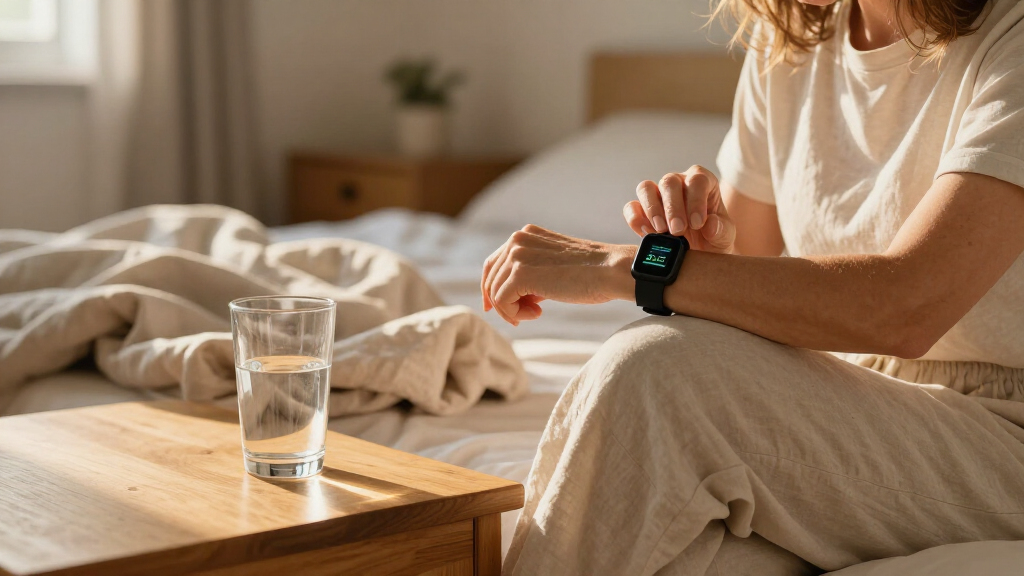
The NC° Band earns my top place because it takes a different approach from the four urine-test kits: it records body temperature overnight and works with the Natural Cycles app to organize cycle information and logged symptoms. For someone trying to spot whether sleep disruption, hot flashes, mood changes, or cycle shifts tend to follow a pattern, regular data collection may be more useful than an isolated hormone result. Its value lies in building a record to discuss with a healthcare provider, not in diagnosing menopause.
Compared with Proov Empower, the Band requires no urine testing and focuses on repeated temperature and symptom context rather than measuring four hormone markers. That makes it the more passive option, but also a less direct way to examine hormones. The app uses Bluetooth and requires a compatible smartphone, so buyers should be comfortable recording symptoms and relying on connected software. The included one-year app subscription is part of the package, but the band is not water resistant, a meaningful limitation for a wearable.
I would choose this over the FSH kits when the main question is how symptoms and cycles behave over time. I would not pick it if I wanted an at-home hormone test, needed a standalone device, or wanted a tracker that could be worn without thinking about water exposure. Its first-place ranking reflects its ongoing, menopause-relevant tracking approach—not a claim that temperature data can identify menopause on its own.
Pros:- Automatically tracks body temperature overnight.
- Combines temperature trends with cycle and symptom logging in the app.
- Includes a one-year Natural Cycles app subscription.
- Can help organize observations for a healthcare-provider discussion.
Cons:- Does not directly measure FSH or other hormones.
- Not water resistant and requires a compatible smartphone and app.
Best for: People who want an ongoing record of overnight temperature, cycle changes, and logged symptoms to support conversations with a healthcare provider.
Not ideal for: Anyone seeking direct hormone measurements, a device that works without a smartphone app, or a water-resistant wearable.
- Included:NC° Band wearable and one-year Natural Cycles app subscription
- Metric measured:Body temperature
- Tracking:Automatic overnight temperature, cycle tracking, and logged symptoms
- Connectivity:Bluetooth
- GPS:No GPS
- Water resistance:Not water resistant
- Compatibility:Smartphone required
Our verdict“For ongoing menopause-related pattern tracking rather than a hormone snapshot, the NC° Band offers the most distinctive approach in this lineup.”
Proov Empower Perimenopause Hormone Tracker for Women
Proov Empower is the broadest hormone-testing option here: it tracks FSH, LH, PdG, and E1G, with a mix of four multihormone tests and three FSH tests intended for two months of tracking. That wider panel separates it from HORMONElife and the other FSH-only strips. For a buyer who wants more than a single-marker screen and prefers an app to help organize results and trends, Proov has the most expansive testing approach in this group.
The Proov Insight app is part of the proposition: it is meant to interpret results, identify trends, and suggest personalized next steps. That may make a series of results easier to review than a handful of unconnected test readings. Still, hormone levels fluctuate, and an app interpretation is not the same as a diagnosis or a substitute for a clinician. Buyers should be ready to follow the kit’s testing routine and treat its output as information to discuss, not a final answer.
Compared with the NC° Band, Proov provides direct hormone-marker testing rather than continuous overnight temperature data and symptom tracking. It also has a substantial access limitation: the product is not available in Alabama, Connecticut, Georgia, Hawaii, Illinois, Maryland, New Jersey, Pennsylvania, Rhode Island, or New York. I rank it second because of its four-marker scope and trend-supporting app, but the geographic restrictions and interpretive complexity make it less universally practical than the wearable.
Pros:- Tracks FSH, LH, PdG, and E1G rather than FSH alone.
- Includes tests intended to support tracking across two months.
- Proov Insight helps organize results and identify trends.
- Offers a more wide-ranging hormone profile than the FSH-only kits.
Cons:- Unavailable in several states due to regulations.
- Hormone fluctuations and results may require professional interpretation.
Best for: People who want to track several hormone markers over two months and can access the kit in their state.
Not ideal for: Residents of the listed restricted states, buyers who want passive wearable tracking, or anyone expecting a home test to diagnose menopause.
- Hormones tracked:FSH, LH, PdG, and E1G
- Included tests:Four multihormone tests and three FSH tests
- Tracking period:Two months
- App:Proov Insight
- App functions:Result interpretation, trend identification, and personalized next steps
- Availability:Not available in AL, CT, GA, HI, IL, MD, NJ, PA, RI, or NY
Our verdict“For buyers who want a multi-marker hormone picture and can obtain it locally, Proov Empower is the most expansive testing kit in this roundup.”
HORMONElife At-Home FSH Menopause Test Strips, 6-Pack
HORMONElife is my pick for a focused FSH screen with unusually clear instructions for repeated testing. The six individually sealed strips cover two three-day testing series. Each series uses first-morning urine on cycle days 3, 4, and 5, and the included color chart provides a semi-quantitative reading across a 0–50 mIU/mL range. The instructions also say to speak with a doctor if two of three results are above 10 mIU/mL.
Those details give this kit more structure than the Carethetic 12-pack, whose supplied information focuses on quantity, sensitivity, and a ten-minute result without the same stated testing schedule or interpretation guidance. HORMONElife also offers app support for logging test results, cycle dates, and symptoms, which can help keep observations together. That is a practical advantage if a buyer wants to bring a record to an appointment, although app logging cannot expand what an FSH-only test tells you.
The tradeoff is a more demanding routine than the five-count midstream kit: you need first-morning urine and specific cycle days, and the result takes ten minutes. Its results are explicitly a screening aid, not a diagnosis. I rank it above the basic FSH strips for the defined schedule and tracking support, but below Proov because it measures only FSH and below the NC° Band for ongoing symptom and temperature context.
Pros:- Six strips support two complete three-day testing series.
- Semi-quantitative color chart covers 0–50 mIU/mL.
- Instructions provide a specific result pattern for discussing with a doctor.
- App support can log results, cycle dates, and symptoms.
Cons:- Requires first-morning urine on cycle days 3, 4, and 5.
- Results are a screening aid, not a diagnosis, and measure FSH only.
Best for: People who want an FSH-focused screen with a specified two-series schedule, a color chart, and app-based logging.
Not ideal for: Anyone who cannot coordinate testing with cycle days, does not want first-morning urine testing, or wants several hormone markers in one kit.
- Test type:Semi-quantitative FSH urine test
- Quantity:Six individually sealed strips
- Measurement range:0–50 mIU/mL
- Recommended testing days:Cycle days 3, 4, and 5, across two series
- Sample:First-morning urine
- Dip and read time:Dip for 10 seconds; read at 10 minutes
- App support:Logs results, cycle dates, and symptoms
- Use limitation:Screening aid, not a diagnosis
Our verdict“HORMONElife suits buyers who value a clearly scheduled, app-loggable FSH screening routine more than a broader hormone panel.”
Carethetic At-Home FSH Menopause Test Strips, 12 Pack
When repeated FSH checks are the priority, Carethetic’s 12-strip pack supplies twice as many strips as HORMONElife and more than either smaller FSH kit. Each strip is individually sealed, and the stated 25 mIU/mL sensitivity with a ten-minute result makes the basic testing proposition easy to understand. This is the straightforward quantity-first option for someone who wants a supply of single-marker tests rather than a wearable or multi-hormone system.
That simplicity comes with less context in the supplied product information. Unlike HORMONElife, Carethetic does not specify a cycle-day schedule, a color-chart range, app support, or a result pattern for when to contact a doctor. Its instructions are described as English-language, but buyers still need to follow the package directions and should not assume that a positive or negative result settles whether they are in menopause. The test measures FSH alone, so it cannot represent the full range of cycle changes and symptoms.
Compared with the five-count midstream strips, Carethetic offers more tests but takes ten minutes to return results rather than three to five. Compared with HORMONElife, it provides a larger supply but fewer stated tracking and interpretation aids. I place it fourth because quantity is its clearest advantage; buyers who want stronger guidance or organized trend logging should look at HORMONElife or Proov instead.
Pros:- Includes 12 individually sealed strips.
- Provides a stated FSH sensitivity of 25 mIU/mL.
- Results are available in 10 minutes.
- Designed for simple at-home urine testing.
Cons:- Product information does not include clinical validation details.
- Measures FSH only and provides limited stated interpretation support.
- No app-based tracking is specified.
Best for: People who want a larger supply of individually sealed FSH strips for simple at-home testing.
Not ideal for: Buyers who want app logging, detailed testing schedules, multi-hormone results, or more interpretation guidance in the product information.
- Test type:Urine FSH test
- Sensitivity:25 mIU/mL
- Result time:10 minutes
- Quantity:12 individually sealed strips
- Instructions:English-language instructions
- Hormone measured:FSH
Our verdict“Carethetic is the quantity-first choice, but its larger strip count does not compensate for limited stated guidance or FSH-only results.”
At-Home FSH Hormone Test Strips for Women, 5 Count
This five-count kit is the most direct fit for someone who wants a cup-free midstream test and a quick result. Hold the absorbent tip in the urine stream for five seconds, then read the dual-line result in three to five minutes. The instructions call for two tests one week apart, so the pack gives you the recommended pair plus three additional strips. Individually sealed foil pouches support convenient storage and private handling.
Its ease of use sets it apart from HORMONElife, which calls for first-morning urine on specific cycle days and a ten-minute read. The tradeoff is that this kit’s stated detection threshold is 25 mIU/mL, and its description does not provide the same app logging, color scale, or threshold-based doctor guidance as HORMONElife. It is also narrower than Proov Empower, which tracks four hormones, though that broader approach involves a more involved system and is not available in several states.
I rank this fifth not because a fast procedure is useless, but because its menopause-tracking support is limited to a basic FSH result and the recommended routine is only described as two tests a week apart. It may work for buyers who prize speed and convenience over a detailed record. Anyone who needs symptom-pattern tracking, multi-marker results, or a clearer cycle-day protocol should compare it with the NC° Band, Proov, or HORMONElife.
Pros:- Midstream application does not require a urine cup.
- Results are read in three to five minutes.
- Individually sealed foil pouches support convenient storage.
- Includes five strips for the recommended pair of tests plus additional checks.
Cons:- Uses a stated detection threshold of 25 mIU/mL and measures FSH only.
- The recommended two-test schedule gives limited long-term tracking context.
- No app support or detailed result interpretation is specified.
Best for: People who prefer a quick midstream urine test without a collection cup and want to follow a two-test schedule.
Not ideal for: Anyone wanting a detailed app-based record, a wider hormone panel, or a clearly specified cycle-day testing protocol.
- Hormone detected:FSH
- Count:Five test strips
- Detection threshold:25 mIU/mL
- Sample:Morning urine
- Application:Midstream; hold absorbent tip in urine stream for 5 seconds
- Result time:Three to five minutes
- Recommended frequency:Two tests, one week apart
- Packaging:Individually sealed foil pouches
Our verdict“Choose this kit for a quick, cup-free FSH check, not for a broad or highly contextual menopause-tracking record.”
How We Picked
I ranked these products by their usefulness for tracking menopause-related changes, not by treating any one reading as proof of menopause. That distinction matters: symptoms, menstrual patterns, temperature trends, and hormone results can each add context, but no product in this roundup replaces a clinician’s assessment. I gave weight to whether a product supports repeated tracking, explains how to use it, and offers a way to organize results or symptoms.
I also compared what each option actually measures. The NC° Band tracks body temperature overnight and depends on app-based cycle and symptom records; it does not measure FSH or other hormones. Proov Empower tests four markers and adds app interpretation, but access is restricted in some states. The remaining three products focus on urine FSH testing, with differences in strip count, sampling method, result time, and instructions. Those distinctions shape the ranking: breadth and usability earn credit, but claims stay within the supplied product details.
Finally, I considered the practical compromises a buyer may face: whether testing must happen on particular cycle days, whether a urine cup is needed, how many tests are included, and whether an app or smartphone is part of the routine. I did not treat a larger pack as automatically better. A higher strip count can support repeat checks, but it does not make an FSH result a complete account of symptoms or reproductive health. Every pick below includes a clear reason to choose it and a reason some buyers may want another option.
Factors to Consider When Choosing Best Health Trackers For Menopause
I would start by deciding whether you want to track patterns, symptoms, or a hormone marker. These products are not interchangeable: a temperature wearable, a multi-hormone kit, and an FSH strip answer different questions and come with different routines.
Choose the type of information you want
If you want to connect symptoms with cycle changes over time, the NC° Band is the clearest match in this lineup. It automatically records overnight temperature, while the app combines that data with cycle information and symptoms you log. This can help you build a timeline, though it does not directly test hormone levels. If your priority is direct hormone testing, Proov Empower is the only option here that tracks four markers. The remaining kits test FSH alone, making them narrower screening tools rather than general health trackers.
Before choosing, decide what you hope a result will help you discuss or track. A single FSH result cannot explain every symptom, and temperature data cannot confirm menopause. A useful tool is one that matches the question you have and gives you a record you can interpret with appropriate medical guidance.
Think about routine and timing
Testing schedules can determine whether a kit fits everyday life. HORMONElife asks for first-morning urine on cycle days 3, 4, and 5, repeated for a second three-day series. That gives the kit a clearly described routine, but it may be inconvenient for irregular cycles or people who do not want to plan around specific days. The five-count kit asks for morning urine and recommends two tests one week apart, with a midstream method and no collection cup.
Carethetic states a ten-minute result and includes 12 strips, but the supplied details do not specify a testing schedule. Proov covers two months with several tests, while the NC° Band is designed for automatic overnight collection rather than urine testing. I would favor the routine you can follow consistently, not the one with the most complicated-looking data.
Understand FSH thresholds and their limits
FSH is a hormone marker, but an at-home result should not be treated as a standalone menopause diagnosis. The kits here also use different measurement descriptions: HORMONElife gives a semi-quantitative 0–50 mIU/mL color chart and its own guidance about discussing repeated elevated readings with a doctor, while the other FSH products list a 25 mIU/mL sensitivity or detection threshold. Those figures are not a complete explanation of how an individual’s symptoms should be assessed.
Hormone levels can vary, and the product descriptions do not provide enough information to compare clinical performance across all the kits. I would use test results as one piece of a broader conversation, especially if symptoms are disrupting daily life, results seem inconsistent, or you need advice about treatment or reproductive health.
Compare app support with privacy and convenience
Apps can make records easier to review, but they also add a phone and data-management step. The NC° Band relies on the Natural Cycles app and Bluetooth; HORMONElife supports logging results, cycle dates, and symptoms; Proov Insight is intended to interpret hormone results and identify trends. By comparison, the product details for Carethetic and the five-count midstream strips do not specify app support.
If you prefer a paper record or do not want another connected device, a strip kit may feel simpler. If you want trends gathered in one place, app tools may help—but I would still check the app’s current requirements and privacy information before use. A wearable also has physical constraints: the NC° Band is not water resistant, so buyers should account for that in their routine.
Check availability and what comes in the kit
Proov Empower has a specific access restriction: it is unavailable in AL, CT, GA, HI, IL, MD, NJ, PA, RI, and NY. Check eligibility before planning around its two-month testing approach. For the FSH kits, strip count is a practical distinction: Carethetic includes 12, HORMONElife includes six for two defined series, and the midstream option includes five with a two-test recommendation.
More tests can support repeat checks, but pack size alone does not tell you whether the method suits your needs. Compare the included instructions, sample method, result time, and any app access. If you have questions about how results relate to your health, take the product instructions and your tracking record to a healthcare professional rather than relying on the test alone.
Frequently Asked Questions
Can an at-home FSH test tell me whether I am in menopause?
No product in this roundup should be treated as a standalone menopause diagnosis. FSH strips offer a reading of one hormone marker, and hormone levels can fluctuate. Menopause-related assessment may also involve menstrual history, symptoms, and other health information. Use the kit according to its instructions and discuss unclear, unexpected, or concerning results with a healthcare professional.
Which option tracks symptoms rather than testing only hormones?
The Natural Cycles NC° Band is the strongest fit for ongoing symptom and pattern tracking because it records body temperature overnight and pairs it with cycle data and symptoms logged in its app. HORMONElife also supports logging symptoms, cycle dates, and FSH results, but its main test is still an FSH screen. Neither app record replaces medical advice.
What is the difference between the FSH kits in this roundup?
HORMONElife includes six strips, a 0–50 mIU/mL color chart, a specified cycle-day schedule, and app logging. Carethetic includes 12 individually sealed strips with a stated 25 mIU/mL sensitivity and a ten-minute result. The five-count kit uses a midstream method, lists a 25 mIU/mL detection threshold, and recommends two tests one week apart. Their instructions and tracking support differ, so I would compare routine and interpretation guidance as closely as strip count.
Is Proov Empower available everywhere in the United States?
No. The supplied product details say Proov Empower is unavailable in Alabama, Connecticut, Georgia, Hawaii, Illinois, Maryland, New Jersey, Pennsylvania, Rhode Island, and New York. Its kit tracks FSH, LH, PdG, and E1G and works with Proov Insight, but buyers in restricted states will need to choose another option or check for updated availability.
Should I take tracker results to a healthcare provider?
A tracking record can give a provider useful context, especially if it includes dates, cycle changes, symptoms, and any test results. The NC° Band can help organize temperature and symptom patterns; HORMONElife offers app logging; and Proov Insight is designed to show hormone trends. These tools do not establish a diagnosis, so I would use them to support a conversation rather than to make treatment decisions on my own.
Conclusion
For ongoing temperature, cycle, and symptom patterns, I would start with the Natural Cycles NC° Band, provided its app requirement and lack of water resistance work for you. For a broader hormone-testing approach, Proov Empower stands out if it is available in your state and you are comfortable interpreting results with appropriate guidance. If you want a defined FSH screening routine with instructions and app logging, choose HORMONElife; if you mainly want more individual strips, Carethetic offers the largest pack.
The five-count midstream kit makes the most sense for buyers who prioritize a quick, cup-free test over detailed tracking. Whichever route you choose, match the product to the information you want and keep its limits in view. I would treat symptoms, test readings, and wearable trends as material for a healthcare conversation—not as a substitute for one.
Cold & flu season Picks
humidifiers
As an affiliate, we earn on qualifying purchases.