
TL;DR

Get wellness gear delivered free with Prime
- Fast, free delivery on millions of items
- Prime Video, Amazon Music and more included
- Member-only deals all year
Fit&Well published a personal trainer’s 10-minute, equipment-free strength circuit for clients over 60. The routine uses chair squats, wall push-ups and standing knee-to-elbow movements, among other exercises, for three rounds; the trainer recommends brief rests and says people should adapt movements to their ability.
Fit&Well has published a personal trainer’s 10-minute, at-home strength circuit for clients over 60, combining five bodyweight movements in three rounds. The routine requires no equipment and includes options for people who need a chair or wall for support, but the trainer cautions that incorrect form can cause pain or injury.
The routine is set up as a circuit: perform 10 repetitions of each exercise, then move to the next. After completing all five movements, repeat the circuit from the start. Fit&Well says three rounds should take around 10 minutes with brief rests, though beginners may need more time while learning the movements.
The exercises are chair squats, wall push-ups, standing knee-to-elbow crunches, glute bridges and bird dogs. The first three are described in the supplied report’s instructions; it identifies the full workout as targeting the lower body, upper body and core. The report recommends doing the circuit three to four times a week, while making clear that it can take longer than 10 minutes at first.
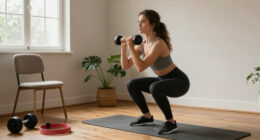
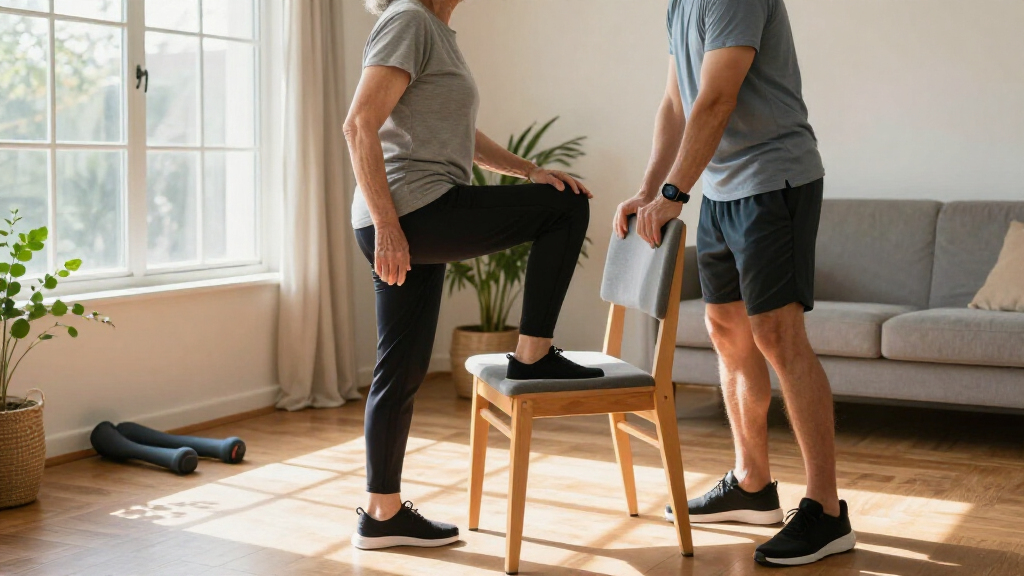
For chair squats, the trainer advises lowering until the buttocks tap the chair, then standing. People who find that difficult can sit fully before rising or hold a stable structure for support. Wall push-ups can be adjusted by changing distance from the wall: standing closer makes them easier, while stepping farther away increases the challenge. During standing knee-to-elbow movements, people with balance concerns can work one side at a time while holding a wall or chair.
A Short Routine With Support Options
The workout offers readers over 60 a short, equipment-free way to practise strength movements at home between sessions with a trainer. Its chair and wall modifications provide ways to reduce the balance or strength demands of some exercises, rather than requiring people to complete every movement in its most difficult form.
The report does not present the routine as suitable for everyone or as a substitute for individual instruction. The trainer says the moves may be appropriate for beginners but can cause pain or injury if performed incorrectly, and recommends learning proper form from a personal trainer. That caution matters because the suggested frequency—three to four times a week—should not override an individual’s health needs, existing pain or exercise restrictions.
Products Worth Considering

Fitbit Versa Smart Watch – Black Aluminum, One Size (S & L Bands Included)

Fitbit Sense Advanced Smartwatch – Sage Grey/Silver (One Size, S & L Bands Included)

Fitbit Versa 2 Health and Fitness Smartwatch with Bonus Bands
As an affiliate, we earn on qualifying purchases.
How the Five-Move Circuit Works
The published instructions emphasize controlled movement and a comfortable range. In the squat, the trainer advises keeping the spine from rounding or the lower back from arching. For wall push-ups, the head, shoulders, hips, knees and feet should remain aligned; the hips should not drift behind the body as the chest approaches the wall.
The standing knee-to-elbow exercise alternates sides, with 10 repetitions on each side. The trainer says touching elbow to knee is not required and recommends moving within a manageable range. People with lower-back issues are advised to move slowly and stay within a range that feels comfortable. The source material does not include detailed step-by-step directions for the glute bridges and bird dogs, so readers should not infer precise technique from the exercise names alone.
“It’s okay if it takes you a bit longer at first.”
— Fit&Well, summarizing the trainer’s advice
Individual Suitability Is Not Established
The supplied report does not identify the trainer by name or provide a publication date. It also does not explain how the routine was evaluated, or establish that it is appropriate for every person over 60. The article’s general recommendation does not account for individual medical conditions, mobility limitations, balance concerns or existing injuries.
The source gives no specific guidance on how to modify or skip the glute bridge and bird dog, beyond naming them as part of the circuit. It is also unclear whether the routine is intended for people who are new to exercise, those returning after a break, or clients already exercising regularly. Readers with pain, health concerns or restrictions on activity should seek advice from a qualified professional before beginning or increasing exercise.
Use the Circuit at Your Own Pace
Fit&Well advises starting with brief rests and allowing more than 10 minutes if needed, then practising until less rest is required. The routine’s suggested schedule is three to four sessions per week; the report also says it may be divided across the day. It does not set a deadline for progressing or specify a required level of improvement.
Before trying the circuit, readers can review the exercise instructions and seek a trainer’s guidance on form and support options. Anyone who experiences pain or has a condition that may affect exercise should pause and consult an appropriate health or fitness professional. The published material provides no further follow-up or update on the workout.
Key Questions
What exercises are in the workout?
The five movements are chair squats, wall push-ups, standing knee-to-elbow crunches, glute bridges and bird dogs. The supplied report provides detailed steps for the first three, but not for the final two.
How many repetitions and rounds does it recommend?
Perform 10 repetitions of each exercise before moving on, then repeat the full circuit for three rounds. The knee-to-elbow movement is listed as 10 repetitions per side.
How often does the trainer recommend doing it?
The report recommends the workout three to four times a week. It says people may split activity across the day, but does not provide individualized scheduling advice.
Can people use support or make the exercises easier?
Yes. The report suggests holding a stable structure during chair squats, sitting fully before standing if needed, and using a wall or chair for balance during knee-to-elbow movements. For wall push-ups, standing closer to the wall makes the movement easier.
Is the workout suitable for everyone over 60?
The source does not establish that it suits every person. The trainer warns that incorrect form can cause pain or injury and recommends learning technique from a personal trainer. People with health conditions, injuries or exercise restrictions should seek professional advice.
Source: fitandwell.com