TL;DR

Get wellness gear delivered free with Prime
- Fast, free delivery on millions of items
- Prime Video, Amazon Music and more included
- Member-only deals all year
A Fit&Well report outlines three scaled squat exercises for people whose heels lift as they squat: a suspension-trainer squat, a slow sit-to-stand and a supported deep squat hold. The report says limited ankle movement may be one factor, but hip mobility or strength may also play a role; the cause for any individual cannot be determined from this sign alone.
Fit&Well has published guidance for people whose heels rise during a squat, describing three modified exercises intended to help practice depth, control and lower-body strength. The report says the pattern is often linked to limited ankle movement, but can also relate to hip mobility or strength, so stretching the calves and ankles may not address every case.
The report explains that a squat requires the shin to move forward over the foot as the hips lower. If ankle dorsiflexion is limited—because of tightness in the calves or ankle joints, for example—the heels may lift as someone tries to squat deeper. The report also says that, for some people, particularly those with weak or tight hips, heel lift could act as a protective response. It does not establish that explanation as the cause in any specific person.
Its first suggested variation is a suspension-trainer squat. Holding the straps provides support while the person bends their knees and lowers into a squat, with feet around hip-width apart or slightly wider and toes turned out a little. The instructions recommend pausing briefly at a comfortable low position and pushing through the heels to stand; the proposed progression is to rely less on the straps as confidence and ability improve.
The other options are a slow sit-to-stand from a sturdy chair and a deep squat hold with the heels supported on thin plates or wedges. The chair variation emphasizes a controlled descent and standing without using the hands. For the supported hold, the report advises keeping the knees apart, the back flat and the chest forward, then gradually reducing heel height over time. It suggests practicing the movements regularly and, when technique feels confident, working toward three sets of one minute with one minute of rest. That routine is the report’s guidance, not a clinical prescription.
Why Squat Heel Lift Matters
A heel lift can make it harder to control a squat through its full range, but it is a movement observation, not a diagnosis. The report’s distinction matters because a person who assumes the issue is solely calf tightness may focus on stretching while overlooking hip strength, mobility or other factors affecting the movement.
The exercises offer graded ways to practice rather than insisting that everyone immediately reach a deep, heels-flat squat. Support from straps, a chair or a small heel elevation can let a person work on control at a manageable level. The report does not provide research data showing how well these exercises work, nor does it claim that they will resolve heel lift for everyone.
Anyone who experiences pain, marked restriction or worsening symptoms should not treat the exercises as a substitute for individualized advice. The source gives general fitness guidance, not an assessment of a reader’s technique or health.
Products Worth Considering

Fitbit Sense 2 Health and Fitness Smartwatch (Lunar White/Platinum)

Therabody Theragun Mini 3rd Generation Massage Gun, Black
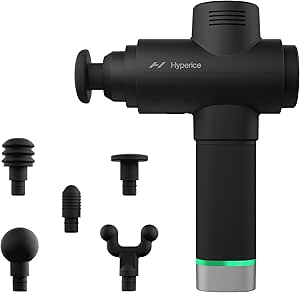
Hyperice Hypervolt 2 Pro Handheld Percussion Massage Gun
As an affiliate, we earn on qualifying purchases.
Ankles, Hips and Squat Depth
In a squat, the ankles bend as the knees travel forward and the hips lower. That ankle motion is known as dorsiflexion. The source describes calf or ankle tightness as a common explanation when the heels rise, while also noting that hip function can matter. These are possible contributors, not a complete list of causes.
Fit&Well presents its exercises as regressions of an unweighted squat: easier or supported versions intended to let someone practice the movement before progressing. The sequence moves from external support, to controlled standing from a chair, to a deep position with the heels elevated. The report recommends reducing assistance or heel height gradually rather than forcing range from the outset.
““For some, however, especially those with particularly weak or tight hips, the heels lifting could actually be a protective mechanism to safeguard the body from injury.””
— Fit&Well report
What Causes Heel Lift?
The source does not identify a single cause of heel lift or explain how to distinguish ankle restriction from hip-related factors in an individual. It also does not cite studies, provide outcome data for the three exercises, or say how quickly a person should expect to improve. Its suggestion that heel lift may serve a protective role is presented as a possibility, not as a diagnosis.
The report does not address every reason someone might have difficulty squatting, such as pain or other movement limitations. Readers should not assume that the exercises are appropriate for all circumstances. If squatting causes pain, or difficulty is persistent or concerning, an appropriately qualified health or exercise professional can help assess the situation.
Progress at a Manageable Pace
The report recommends beginning with the supported versions, paying attention to comfort and control, and progressing gradually. In its suggested progression, suspension-trainer support is reduced over time, chair descents become more controlled, and the heel support under the deep squat is lowered as the position becomes manageable. It advises practicing the movements regularly for a few weeks, though it gives no specific expected results or guarantee.
For readers, the next step is to choose a version that can be performed comfortably and stop if it causes pain. A professional assessment may be useful if the issue persists or if there are other symptoms. No further study results, clinical guidance or follow-up information are provided in the source material.
Key Questions
Why do my heels come up when I squat?
Limited ankle dorsiflexion, which can be related to calf or ankle tightness, is one possible explanation in the Fit&Well report. The report also says hip mobility or strength may contribute for some people. Heel lift alone does not confirm a particular cause.
Will stretching my calves fix the problem?
Not necessarily. The report says ankle and calf stretching alone may not address heel lift when hip mobility or strength is also involved. It does not provide an assessment method for determining which factor applies to you.
What three exercises does the report suggest?
It describes a suspension-trainer squat, a slow sit-to-stand from a sturdy chair, and a deep squat hold with the heels supported on plates or wedges. The variations are presented as ways to practice squat movement progressively.
Should I keep doing the exercises if squatting hurts?
The report does not give a pain-management protocol. Do not force a painful movement; consider seeking advice from an appropriately qualified health or exercise professional, particularly if pain persists or the limitation is concerning.
Source: fitandwell.com