
TL;DR

Get wellness gear delivered free with Prime
- Fast, free delivery on millions of items
- Prime Video, Amazon Music and more included
- Member-only deals all year
A Fit&Well report recommends four exercises—seated knee lifts with sit-to-stands, a dumbbell hold with leg raises, farmer carries and shoulder presses—to practise strength and balance. The routine is presented as a way to work muscles used in everyday tasks; the source does not provide research evidence that it prevents falls or guarantees future independence.
Fit&Well has published a four-move strength and balance routine from an instructor who teaches chair workout classes to adults in their late 60s through early 90s. The exercises use a sturdy chair and dumbbells, and are framed around tasks such as getting out of a seat, walking with bags and reaching overhead.
The routine combines seated knee lifts with sit-to-stands, a dumbbell hold with a side leg raise, a farmer carry and a shoulder press. The instructor recommends eight repetitions for each move, per side where relevant, and two rounds overall. Farmer carries are prescribed for 30 seconds, followed by 30 seconds of rest.
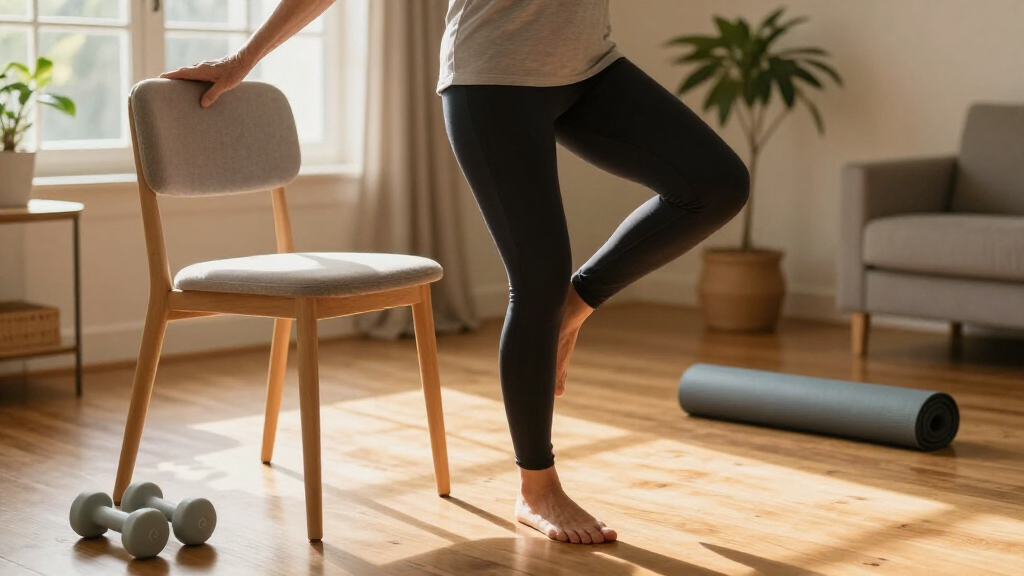
For the first exercise, sit near the front of a sturdy chair and lift each knee in turn. With both feet on the floor, lean forward slightly, stand by pushing through the feet, then lower back into the chair with control. The source says the knee lifts work the hip flexors used to move the legs, while standing and sitting practise movements involved in rising from a low seat.
For the side leg raise, stand holding a dumbbell in one hand and lift the opposite leg out to the side without leaning. Switch sides after eight repetitions. In the farmer carry, walk with a dumbbell in each hand, keeping the torso upright, then lower the weights by bending the hips and knees. The shoulder press can be done seated or standing: hold dumbbells at shoulder height, press overhead without arching the lower back, and lower them slowly.
Training for Everyday Tasks
The instructor connects each movement to practical activities: standing up from a chair or car seat, moving the legs, walking while carrying shopping and placing objects on a high shelf. That focus may help readers understand how a basic strength routine can relate to daily function, rather than treating exercise as a set of movements without a clear purpose.
The report also describes outcomes the instructor says clients have experienced. One client who had a hip replacement was praised by a nurse for upper-body strength that helped her get out of a hospital bed, the instructor writes. Other clients reportedly found it easier to enter a family member’s car, swim longer or walk farther to a bus stop. These are personal examples reported by the instructor, not controlled evidence that this particular routine caused those changes.
The instructor argues that practising such movements in middle age could help people build strength for later life. The article offers a practical routine, but does not establish that doing it will preserve independence, prevent falls or produce the same outcomes for everyone.
As an affiliate, we earn on qualifying purchases.
How the Routine Is Set Up
The source is a Fit&Well exercise report written from the perspective of a chair-workout instructor. The instructor says their regular participants range from their late 60s to early 90s and often want to maintain independence in daily activities. The publication date is not included in the material supplied here.
The full routine calls for a sturdy chair and a pair of dumbbells. It advises readers to begin with weights they can control throughout each movement. The movements can be done seated or standing where specified, and the chair can be used for balance during the knee lifts. The supplied report does not describe a warm-up or provide individualized programming.
As an affiliate, we earn on qualifying purchases.
Evidence and Individual Suitability
The supplied report does not cite studies testing this exact four-exercise routine, quantify its effects or give a publication date. It is also unclear how the routine should be adapted for people with different levels of mobility, balance, pain or experience with weights. The client examples are accounts from the instructor and do not establish that the exercises caused the reported improvements.
Readers should choose a weight they can control and stop if a movement causes pain, dizziness or unusual discomfort. Anyone with a health condition, recent surgery, a history of falls or concerns about exercising should seek guidance from a qualified health professional or exercise specialist before starting. Use a stable chair and clear space, and have support nearby if balance is uncertain.
balance and strength training guide
As an affiliate, we earn on qualifying purchases.
As an affiliate, we earn on qualifying purchases.
Starting With a Manageable Routine
The instructor’s suggested starting point is two rounds of the four exercises, with eight repetitions per move or side and 30-second farmer carries. The source does not set out a schedule for how often to repeat the routine, how quickly to increase the weights or when to progress to harder versions. Those choices will depend on a person’s current ability and goals.
Readers interested in the routine can begin with a comfortable load and controlled movements, using the chair for support where needed. A clinician or qualified instructor can help adapt it to individual needs. The report does not announce a follow-up study or a later milestone, so any broader evidence about outcomes remains outside the information provided.
As an affiliate, we earn on qualifying purchases.
Key Questions
What are the four exercises?
The routine includes seated knee lifts with sit-to-stands, a dumbbell hold with a side leg raise, farmer carries and shoulder presses.
How many repetitions does the report recommend?
The instructor suggests eight repetitions per exercise, per side where relevant, and two rounds. Farmer carries are timed for 30 seconds, with 30 seconds of rest.
What equipment is needed?
The routine calls for a sturdy chair and a pair of dumbbells. The report advises starting with weights that can be controlled throughout each movement.
Does this routine prevent falls or guarantee independence?
No such outcome is established in the supplied report. It links the exercises to tasks that use strength and balance, but does not provide trial results or evidence that the routine prevents falls or guarantees independence.
Should someone with health or balance concerns try it?
People with health conditions, recent surgery, a history of falls or uncertainty about safe movement should ask a qualified health professional or exercise specialist for guidance before starting.
Source: rss
Halloween Picks
halloween
As an affiliate, we earn on qualifying purchases.