
TL;DR
Barre instructor Tara Riley has shared a five-minute, equipment-free arm routine that uses continuous, controlled movements to challenge arm endurance and shoulder stability. The sequence includes five movements, repeated in a set order; its expected benefits are Riley’s description of the workout, not results from a reported clinical study.
Barre instructor Tara Riley has outlined a five-minute, equipment-free arm workout intended to challenge muscular endurance and shoulder stability through continuous, controlled movements. Published by Fit&Well, the routine uses five exercises repeated in a set sequence and is designed to be performed to Ed Sheeran’s song “Bad Habits.”

Get wellness gear delivered free with Prime
- Fast, free delivery on millions of items
- Prime Video, Amazon Music and more included
- Member-only deals all year
The workout is based on bodyweight barre movements, a style inspired by ballet that uses small, controlled actions rather than weights. Riley says participants should keep their arms moving through the song without stopping. She describes the routine as a way to make the muscles work for longer, rather than as a substitute for every kind of resistance training.
The five movements are a figure of eight, bend and press, small arm circles, pull and press, and lateral arm wave. They involve holding the arms around shoulder height, making circles, bending and extending the elbows, and alternating the arms. The sequence repeats several movements: figure-of-eight motions and bend-and-press repetitions appear more than once.
Fit&Well’s instructions specify a mix of slow and faster repetitions, including eight slow and 16 fast figure-of-eight movements, 16 circles in each direction, and sets of single-arm and two-arm presses. The full sequence is listed as figure of eight, bend and press, small circles, pull and press, bend and press again, figure of eight, lateral arm wave, bend and press, and a final figure of eight.
A Short Session Focused on Endurance
The routine offers readers a brief option that requires no equipment and can be done at home. Riley frames its main training emphasis as stamina: repeated, low-load movements keep the arms working continuously, which may suit people looking to practise sustaining effort rather than lifting heavier loads.
Riley also says the movements challenge shoulder control in different directions and ranges. She links that control to everyday tasks such as lifting, carrying, reaching, and holding the arms overhead. Those are the instructor’s stated aims, not a guarantee that five minutes will produce a specific fitness result. The source does not report measured outcomes or compare the workout with other exercise programs.
For readers deciding how to use the session, the distinction matters: the workout is presented as an accessible endurance challenge, especially for people familiar with resistance training, while Riley describes it as an introduction for beginners. Individual ability and experience will affect how challenging the sequence feels.
Products Worth Considering

Garmin Venu 4 GPS Smartwatch, 45 mm, Slate with Black Silicone Band

Therabody Theragun Relief Massage Gun, 3-Speed, Navy

Garmin Forerunner 165 GPS Running Smartwatch, 43 mm, Black
As an affiliate, we earn on qualifying purchases.
How the Routine Is Structured
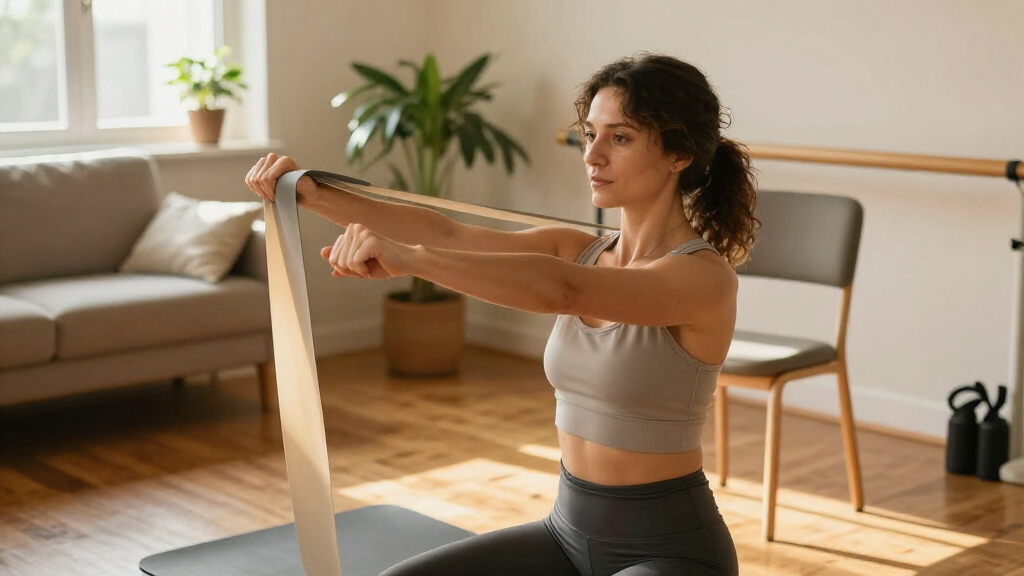
Barre combines ballet-influenced positioning with small, repeated movements. In this routine, participants stand with feet about hip-width apart and generally extend their arms to the sides at shoulder height. The movements are designed to flow together rather than be treated as isolated strength sets with rest periods.
Riley says people who are new to exercise may find the session an introduction to strength workouts, while those with more resistance-training experience may use it to work on muscular endurance. The article’s detailed instructions give repetition counts for each exercise, but the workout is also timed to a song, so the pace may depend on how a participant follows the music and exercise cues.
The routine is not presented as a medical intervention or as a comprehensive strength program. It focuses on the arms and shoulders, and the source material does not provide a broader weekly training plan, progression schedule, or advice for people with existing shoulder problems.
“I love lifting weights too, but never underestimate just how much you can challenge your muscles without holding a single thing.”
— Tara Riley, barre instructor
No Measured Results Are Reported
The source describes the workout’s intended benefits but does not provide research findings, participant data, or measured changes in muscular endurance or shoulder stability. It is not clear how much improvement a person could expect, how frequently the routine should be repeated, or how its effects compare with other training.
The instructions also do not give modifications for different ability levels or specific guidance for people with pain or a history of shoulder injury. The listed repetition counts and five-minute framing may not suit everyone at the same pace. Readers should stop if a movement causes pain and seek advice from a qualified health professional when an existing condition affects exercise choices.
Readers Can Follow the Listed Sequence
The article provides a complete sequence that readers can try by following the listed repetitions and keeping their movements controlled. It does not announce a follow-up study, new program, or additional milestone. Anyone trying the routine can adjust the pace or pause as needed rather than treating continuous movement as a requirement if it feels unsafe or unmanageable.
For readers seeking a broader plan, the source does not specify how often to perform this session or how to progress it over time. That guidance would be needed before treating the five-minute routine as a structured training program.
Key Questions
What is the five-minute barre arm workout?
It is an equipment-free sequence of five movements: figure of eight, bend and press, small arm circles, pull and press, and lateral arm wave. Several movements repeat in the order listed by Fit&Well.
What does the workout aim to improve?
Riley says the routine is intended to challenge muscular endurance and shoulder stability. The source does not report measured results or guarantee a particular level of improvement.
Do I need weights or other equipment?
No. The routine is described as a bodyweight workout and does not require equipment. It is meant to be done standing, with repeated arm movements.
Should I keep moving for the whole song?
Riley says the movements are designed to flow continuously through “Bad Habits.” The source does not say participants must ignore discomfort; people should slow down or stop if needed, especially if they experience pain.
How often should I do this workout?
The source does not recommend a frequency or provide a progression plan. People with existing shoulder concerns or other conditions affecting exercise can consult a qualified health professional about suitable activity.
Source: fitandwell.com