
Choosing an infrared therapy mat comes down to whether you want a straightforward heated mat or a model that adds near- and mid-infrared wavelengths, often with extra controls and a higher price. Far-infrared mats are usually the simpler, less expensive choice for people seeking warmth during a relaxation routine. Full-spectrum mats appeal to buyers who specifically want broader wavelength coverage and are comfortable paying more for it. The practical difference is less about a guaranteed health advantage—claims vary and should be checked against reliable evidence—and more about features, cost, and how you plan to use the mat.

Get wellness gear delivered free with Prime
- Fast, free delivery on millions of items
- Prime Video, Amazon Music and more included
- Member-only deals all year

Comfytemp Red Light Therapy Pad for Body, 41.5" x 26", 660nm & 850nm
- ✔ Dimensions: 41.5 × 26 inches
- ✔ Wavelengths: 660 nm red and 850 nm near-infrared
- ✔ Lamp beads: 560 dual-chip beads
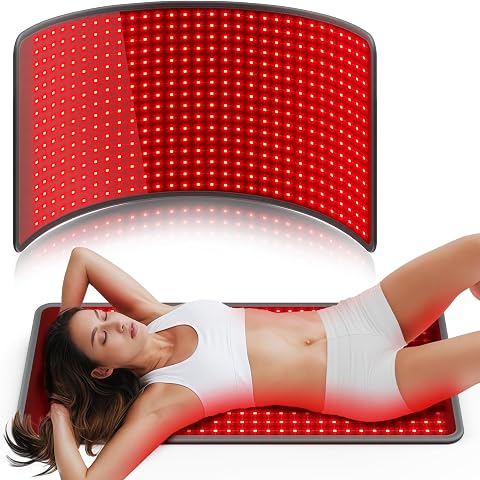
Comfytemp Red Light Therapy Mat for Body, 33" x 17", 660nm & 850nm
- ✔ Dimensions: 33 × 17 inches
- ✔ Wavelengths: 660 nm red and 850 nm near-infrared
- ✔ LED count: 480
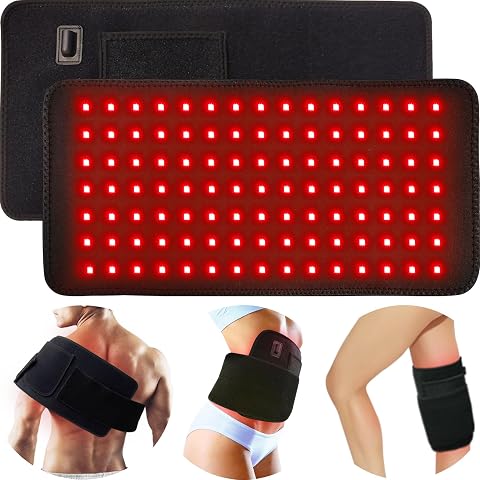
Corded Red Light Therapy Pad with 3-in-1 Chips for Body, Back, Knee, Shoulder, Hands, Feet – 660nm Red + 850nm NIR, Adjustable Wr…
- ✔ Pad dimensions: 16.1 × 7.9 inches
- ✔ Strap length: 35.2 × 4 inches
- ✔ Weight: 0.44 lb
At a Glance
| Criteria | Far-infrared therapy mats | Full-spectrum infrared therapy mats | Winner |
|---|---|---|---|
| Wavelength approach | Primarily far-infrared wavelengths; product details vary. | Combines far-infrared with near- and mid-infrared wavelengths, depending on the product. | B |
| Heating and comfort | Provides a heated surface; warmth depends on settings, materials, and design. | Also heats the surface; wavelength range alone does not establish a more comfortable session. | Depends |
| Controls and features | Often offers basic temperature and timer controls, though models differ. | May add wavelength controls or other features, but verify the exact model specifications. | B |
| Setup and routine | Generally straightforward: place it on a suitable surface, set controls, and follow the manual. | Can require more setup or decision-making if it has extra modes and accessories. | A |
| Price and value | Typically the more affordable route to an infrared-style heated mat. | Usually costs more; the premium buys expanded features, not a proven outcome. | A |
| Evidence and claims | Heat may feel relaxing, but broad claims about treating conditions should not be assumed. | Claims still need careful scrutiny; a wider wavelength range does not by itself prove added health benefits. | Tie |
Comfytemp Red Light Therapy Pad for Body, 41.5" x 26", 660nm & 850nm
For buyers who want one mat to span a broad area, this Comfytemp has the clearest advantage in the lineup: its 41.5 × 26-inch surface is substantially larger than the 33 × 17-inch Comfytemp and the bonodave’s 16.1 × 7.9-inch pad. That footprint makes it the most compelling choice for placing across a larger body region or positioning multiple areas over the course of a session. Its 560 dual-chip lamp beads and two listed wavelengths give it a substantial feature set, though bead count alone does not establish how much light reaches the body.Controls remain straightforward, with four modes and three intensity levels operated through a one-button setup. That combination gives users some room to adjust sessions without the more involved controls some buyers may prefer. Compared with the smaller Comfytemp mat, the larger pad favors coverage over ease of storing or handling. Compared with bonodave, it lays flat instead of wrapping securely around a joint or limb.The key caveat is that the description says clothing thickness or color can reduce light effectiveness, so placement and use conditions matter. It is also corded, and its broad shape may be awkward in a cramped space. We would choose it for home routines centered on maximum surface area; we would skip it if compact storage or hands-free wrapping is the priority.
Pros:
- Largest stated coverage area in this lineup at 41.5 × 26 inches
- Lists both 660 nm red and 850 nm near-infrared wavelengths
- Four modes and three intensity levels offer adjustment options
- One-button controls are designed for straightforward home use
Cons:
- Large dimensions may be inconvenient to store or position in a small space
- The description notes that clothing thickness or color can reduce light effectiveness
- Corded operation limits placement to locations with power access
Best for: Home users who want the broadest flat surface in this comparison and have room to position and store a larger pad.
Not ideal for: Buyers seeking a compact, wrap-style device, or anyone who needs to use a pad away from a power connection.
Bottom line: We rank this first for its unusually broad surface and simple adjustable controls, provided its size suits the home setup.
“We rank this first for its unusually broad surface and simple adjustable controls, provided its size suits the home setup.”
Comfytemp Red Light Therapy Mat for Body, 33" x 17", 660nm & 850nm
The 33 × 17-inch Comfytemp sits between the largest pad and bonodave’s narrow wrap, making it the balanced flat-mat pick for buyers who want a broad panel without the largest model’s footprint. Its stated coverage is useful for a more contained treatment area, but it cannot match the 41.5 × 26-inch version when spreading light over a larger surface is the main priority. And unlike bonodave, it is not described as a flexible strap-on pad for securing around a specific body part.Its 480 LEDs and 660 nm plus 850 nm wavelengths are paired with four modes and three intensity levels. The controls offer a similar level of choice to the larger Comfytemp, while the smaller dimensions may make it easier to place in a home routine. Still, the provided description does not specify a timer or attachment system, so buyers who want timed sessions or a hands-free wrap should look more closely at bonodave’s stated features.This mat is plug-and-play, but the power outlet requirement limits portability. That tradeoff is shared by the two other products, so it does not distinguish the mat within this lineup; it does matter if you expect to move between rooms or use the device where outlets are inconvenient. We see it as a sensible middle choice when a compact wrap feels too small and the biggest pad seems excessive.
Pros:
- 33 × 17-inch surface offers a middle size between the other two picks
- 480 LEDs deliver the listed 660 nm red and 850 nm near-infrared wavelengths
- Four light modes and three intensity levels allow session adjustments
- Plug-and-play operation keeps setup simple
Cons:
- Smaller coverage than the 41.5 × 26-inch Comfytemp pad
- No strap or timed-session feature is specified in the provided details
- Requires a power outlet, which limits portability
Best for: Buyers who want a medium-sized flat mat with adjustable modes and intensity, without choosing the largest pad in the group.
Not ideal for: People who need the broadest possible surface, a strap to hold the pad in place, or operation away from a power outlet.
Bottom line: We recommend this model for a manageable flat mat with useful control options, though it gives up the largest pad’s reach and bonodave’s wrap fit.
“We recommend this model for a manageable flat mat with useful control options, though it gives up the largest pad’s reach and bonodave’s wrap fit.”
Corded Red Light Therapy Pad with 3-in-1 Chips for Body, Back, Knee, Shoulder, Hands, Feet – 660nm Red + 850nm NIR, Adjustable Wr…
Bonodave takes a different approach from both Comfytemp models: it is a flexible wrap for targeted areas, rather than a broad, flat mat. The 16.1 × 7.9-inch pad and 35.2-inch strap are intended to help position it around areas such as a knee, shoulder, or back. That fit can be more practical when a large panel would be cumbersome, although its smaller surface means it is not the pick for covering a wide area at once.The listed 315 LEDs use three-in-one chips and provide 660 nm red plus 850 nm near-infrared light. Bonodave also specifies a 10 Hz pulse mode and timed 30-minute sessions, features not listed for either Comfytemp model. Those controls may suit someone who prefers a defined session and an adjustable belt; buyers who prioritize a flat mat with wider coverage should compare it with the 33 × 17-inch Comfytemp or the much larger 41.5 × 26-inch version.At 0.44 lb, the pad itself is light, but its USB cord still ties use to a power source. The product description frames USB power as convenient for home or office use, yet the cord remains a practical constraint on movement and placement. We would choose bonodave for localized positioning and a strap-based fit, and pass if broad coverage is the deciding factor.
Pros:
- Adjustable strap supports a wrap-style fit on several body areas
- Lists 660 nm red and 850 nm near-infrared LEDs
- 10 Hz pulse mode and timed 30-minute sessions are specified
- Lightweight pad weighs 0.44 lb and uses USB corded power
Cons:
- Much smaller pad surface than either Comfytemp option
- Corded USB power still limits where it can be used
- The strap-based fit may be less convenient than laying a broad pad flat
Best for: Someone who wants a lightweight, flexible pad with a strap for positioning on one body area and timed sessions.
Not ideal for: Buyers seeking a full-size flat mat or wide simultaneous coverage across multiple body areas.
Bottom line: Bonodave is the most specialized choice here: its wrap, pulse mode, and timer suit targeted sessions, but its small surface rules it out for broad coverage.
“Bonodave is the most specialized choice here: its wrap, pulse mode, and timer suit targeted sessions, but its small surface rules it out for broad coverage.”
As an Amazon Associate we earn from qualifying purchases.
Key Differences
The clearest distinction is simplicity versus expanded specification. Far-infrared mats concentrate on a heated surface and commonly have fewer choices to manage. Full-spectrum mats include additional wavelength bands and may bundle more controls or accessories. That can matter to a buyer who has researched the specific wavelengths and wants those features; it may add little to someone whose main goal is a comfortable, easy-to-use heat session.
Price is part of the same tradeoff. A higher-priced full-spectrum mat can be a reasonable purchase when its extra features match a buyer’s stated preferences, but the broader label is not proof of superior results. Compare temperature range, timer, materials, dimensions, warranty, safety instructions, and return terms. For either type, treat claims about pain relief, detoxification, circulation, or disease treatment cautiously, and consult a health professional about medical concerns.
Detailed Comparison
Wavelength approach (Full-spectrum infrared therapy mats wins — moderate)
Far-infrared mats emphasize longer wavelengths and a simple heat-focused design. Full-spectrum models add near- and mid-infrared bands, giving B the wider wavelength specification. This is a moderate advantage only for shoppers who specifically value those bands; the label alone does not establish a better health outcome.
Heating and comfort (minor difference)
Both types are heated mats, and the comfort of a session depends heavily on temperature control, surface materials, size, and personal preference. Neither category automatically provides gentler or more effective heat. This is a minor distinction at the category level, so compare the actual product settings and construction.
Controls and features (Full-spectrum infrared therapy mats wins — moderate)
Full-spectrum products often include more controls or bundled features, so B may suit buyers who want options beyond basic heating. Those additions vary by model and can complicate operation. Far-infrared models often keep the routine more direct. The gap is moderate when a specific feature matters and minor when it does not.
Setup and routine (Far-infrared therapy mats wins — minor)
A basic far-infrared mat is often easier to select and operate because there may be fewer modes and settings. Full-spectrum models can take more comparison and adjustment. A wins slightly for people who value a low-fuss routine; buyers who enjoy customizing settings may not see this as a drawback.
Price and value (Far-infrared therapy mats wins — moderate)
Far-infrared mats are generally less expensive, making A the stronger value for a buyer who mainly wants a warming mat. B’s higher cost makes sense only if its added wavelength range, controls, or construction are worth that premium to the individual. The difference is moderate because prices and included features vary widely by model.
Evidence and claims (major difference)
Neither type should be chosen on sweeping claims that infrared heat cures illness or reliably produces specific medical outcomes. A broader wavelength range does not prove that B is more effective. Buyers should evaluate product claims carefully and seek clinical advice for symptoms or a medical condition. There is no category-level winner.
Far-infrared therapy mats: Pros and Cons
Pros:
- Usually costs less than a full-spectrum model.
- Often offers a simple heat-focused routine.
- Can be a practical choice when warmth and basic controls are the priorities.
Cons:
- Does not include the additional wavelength bands found in full-spectrum products.
- Features and quality still vary, so the category label is not a substitute for checking specifications.
- Marketing may overstate what infrared heat can do.
Full-spectrum infrared therapy mats: Pros and Cons
Pros:
- Includes a broader wavelength range by design.
- May offer more controls, modes, or bundled features, depending on the model.
- Fits buyers who specifically want to compare near-, mid-, and far-infrared offerings.
Cons:
- Usually carries a higher price.
- More features can mean more setup and choices.
- The wider spectrum does not by itself establish better health results.
Who Should Choose What
Choose Far-infrared therapy mats if:
- You mainly want a heated mat for relaxation and prefer a simple routine.
- You want to keep spending lower and do not value added wavelength bands.
- You prefer fewer settings and plan to choose based on comfort, safety, and warranty.
Choose Full-spectrum infrared therapy mats if:
- You have a clear reason to want near- and mid-infrared wavelengths as well as far-infrared.
- The specific model offers controls or construction features you will use regularly.
- You are comfortable paying a premium for the expanded specification without treating it as a promise of better medical results.
Skip both if: Skip both if you need a proven treatment for a medical condition, expect the mat to replace clinical care, or cannot use heated products safely under the manufacturer’s guidance.
Value for Money
For most buyers who simply want a warm surface for a relaxation routine, the less expensive far-infrared mat is the better value. Paying more for full-spectrum is worthwhile when the broader wavelength range or a specific added feature is a genuine preference, not because the name sounds more advanced. Before spending extra, compare the actual temperature settings, timer, dimensions, materials, warranty, safety instructions, and return policy. Those practical details can matter more to daily use than the category label.
Final Verdict
Choose a far-infrared mat if warmth, straightforward controls, and lower cost are your priorities. Choose a full-spectrum model if you specifically want its additional wavelength bands or verified features and accept the higher price. For most shoppers without a clear need for the expanded specification, far-infrared is the sensible starting point. The deciding factor is whether the full-spectrum model offers something you will actually use; its broader range alone is not a reason to expect better health outcomes.
Frequently Asked Questions
Is a full-spectrum infrared mat better than a far-infrared mat?
It covers more wavelength bands, but that does not automatically make it better for comfort or health. The best fit depends on the specific features you want and the product’s documented specifications.
Is the extra cost of a full-spectrum mat worth it?
It can be if you specifically value the added wavelengths or a feature included with the model. If you mainly want a simple heated mat, a far-infrared option is usually better value.
Do infrared therapy mats treat medical conditions?
Do not assume that a mat treats or cures a condition based on marketing claims. Evidence and appropriate care depend on the health issue; ask a qualified health professional about symptoms or treatment decisions.
What should I compare before buying either type?
Check temperature range, timer, mat size, surface materials, safety instructions, warranty, and return terms. Confirm the stated wavelength details for the exact model rather than relying only on a product category name.