TL;DR
Fit&Well published a three-exercise resistance-band routine from trainer Anneli Marinovich, intended to strengthen the core, back and glutes. The routine is not a proven treatment for back pain; the report advises consulting a health professional before trying it, especially if you already have symptoms.
Fit&Well has published a 10-minute resistance-band routine from personal trainer and menopause coach Anneli Marinovich, featuring three exercises aimed at strengthening the back, glutes and core. The report says people with back pain should consult a health professional before trying new exercises; it does not establish that the routine prevents or treats pain.

Get wellness gear delivered free with Prime
- Fast, free delivery on millions of items
- Prime Video, Amazon Music and more included
- Member-only deals all year
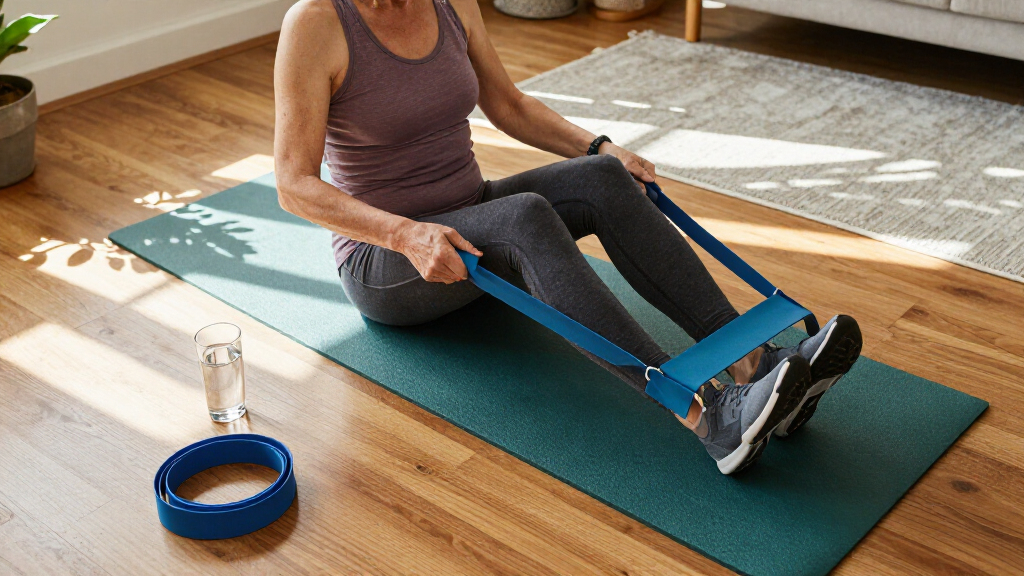
The routine uses a long loop resistance band and, ideally, a short loop band, though the report says a long band can be doubled, much like the equipment used in daily resistance-band exercises. Marinovich recommends completing three rounds, with 45 seconds of rest between rounds. The listed exercises are band pull-aparts for 10 repetitions, banded glute bridges for 10 repetitions, and bird dogs for five repetitions on each side.
For the pull-apart, stand with the band held in front of the chest and pull it outward while squeezing the shoulder blades together, then return slowly. For the bridge, lie on your back with knees bent and a short band above the knees; press through the heels to raise the hips while gently pushing the knees outward, a useful reminder of the role of heel position in lower-body exercises. Lower with control.
For the bird dog, begin on hands and knees and extend one arm forward while raising the opposite leg behind you. Hold briefly while keeping the torso steady, return to the starting position, and switch sides. Marinovich says the exercises focus on the body’s “posterior armour” — the back, glutes and deep stabilisers — rather than abdominal work aimed mainly at appearance.
A Strength Routine, Not a Pain Cure
Lower-back pain can affect daily activity, and Fit&Well notes that it becomes more common with age. Exercises that build strength may be useful for some people when appropriately recommended, but a general routine cannot account for the cause or severity of an individual’s symptoms.
The practical value of the report is that it offers a short, equipment-light sequence with clear repetition and rest guidance. Its instructions may help readers understand what the movements involve, but the trainer’s stated aims are not evidence that this particular workout will prevent pain, improve balance or make everyday tasks easier for every person.
Medical guidance comes first for anyone experiencing back pain. A doctor or physical therapist can advise whether these movements are suitable and whether they need modification. Stop if an exercise causes or worsens symptoms, and ask a qualified professional what to do next.
Products Worth Considering

Garmin Venu 4 GPS Smartwatch, 45 mm, Slate with Black Silicone Band

Oral-B iO5 Rechargeable Electric Toothbrush with Visual Pressure Sensor, Travel Case, and 3 Brush Heads (Black)

Philips Sonicare 5950 Rechargeable Electric Toothbrush with 2 Brush Heads, Pink
As an affiliate, we earn on qualifying purchases.
How the Three Moves Fit Together
Marinovich presents the exercises as a combined strength routine rather than as separate treatments. The pull-apart uses the upper back and shoulder-blade area; the bridge emphasizes the glutes and hips; and the bird dog asks the trunk to remain stable while the limbs move. The report characterizes the sequence as work for the back, glutes and deep stabilisers.
Her comments explain the reasoning behind the selection, not independently verified outcomes. She describes pull-aparts as a counter to a forward-leaning desk posture, bridges as support for the lower-back and glute complex, and bird dogs as practice stabilising the spine. Fit&Well does not provide trial results, clinical evidence specific to this exact routine, or a comparison with other exercise programs.
““A strong lower back and glute complex takes the pressure off the lumbar spine and makes standing up from a chair effortless.””
— Anneli Marinovich
Evidence and Individual Suitability
The source does not specify a publication date or cite research testing this three-move sequence. It also does not report how many people have tried the routine, whether it reduced pain, or how long any effects lasted. Marinovich’s descriptions of potential benefits should be understood as her views, not confirmed outcomes.
It is also unclear whether the routine suits people with different causes of back pain, mobility limitations or other health conditions. The source gives no adaptations beyond doubling the long band if a short loop is unavailable. Anyone with current back pain should seek advice from a doctor or physical therapist before beginning, as the report itself recommends.
Seek Advice Before Starting
The report does not announce a clinical trial, follow-up study or further testing. For readers considering the routine, the next step is to discuss exercise with a health professional, particularly if back pain is present. A clinician or physical therapist can assess suitability, demonstrate technique and suggest adjustments based on symptoms and ability.
If cleared to exercise, readers can follow the stated structure — three rounds, 45 seconds of rest between rounds — while paying attention to comfort and control. The source does not offer a timetable for results or a recommended frequency beyond presenting the workout as a short routine, so readers should not infer either from the article.
Key Questions
What exercises are included in the routine?
The routine includes band pull-aparts for 10 repetitions, banded glute bridges for 10 repetitions, and bird dogs for five repetitions on each side.
How many rounds does the workout call for?
Marinovich’s workout instructions say to complete three full rounds, resting for 45 seconds between rounds.
Can these exercises prevent or treat lower-back pain?
The report presents them as a strength routine intended to support the back, glutes and core. It does not establish that they prevent or treat pain. Anyone with back pain should consult a health professional before trying them.
What equipment is needed?
The routine calls for a long loop resistance band and ideally a short loop band. Fit&Well says the long band can be doubled if a short one is not available.
Source: fitandwell.com